Isaac Newton
Who was Isaac Newton? Find out by watching the video and reading along.
There is a worksheet available at the bottom of the page to check your English .
|
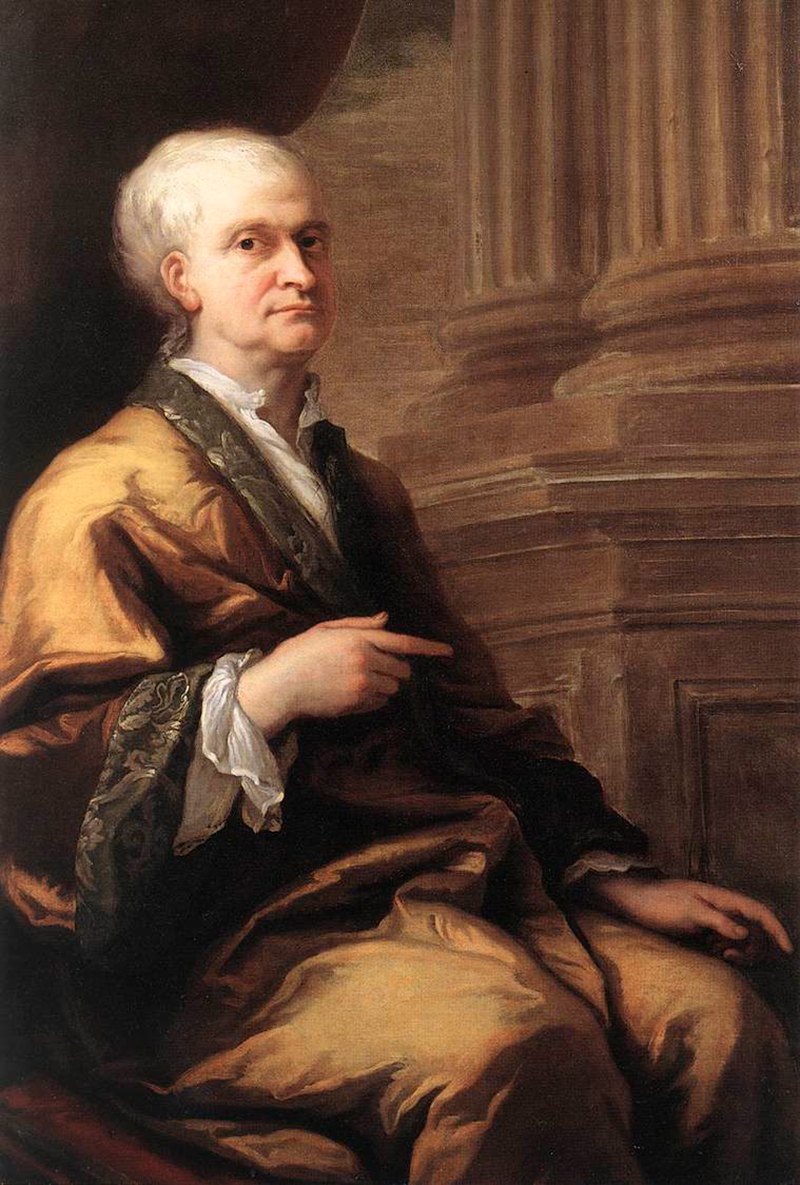
Sir Isaac Newton FRS PRS (25 December 1642 – 20 March 1726/27) was a “natural philosopher” – a mathematician, physicist, astronomer, theologian, and author. He is widely recognised as one of the most influential scientists of all time, and was a key figure in the scientific revolution.
Newton remains a famous name today, and his discoveries in researching motion and gravity are still taught today. Newton is often said to have discovered gravity. Newton’s book, Philosophiæ Naturalis Principia Mathematica ("Mathematical Principles of Natural Philosophy"), first published in 1687, laid the foundations of classical mechanics, and he made important contributions to optics and calculus. Newton's three laws of motion are taught in schools even today, and state:
These laws were the basis of understanding movement and motion for 200 years, and remain applicable to "macro" sizes. They explain everything from the design of vehicles to the movement of the planets. It was only with Einstein's theories regarding relativity that a new series of laws was developed, to explain forces at microscopic scales, and at speeds closer to the speed of light. However, Newton was not himself a "scientist" in the modern sense of the word. He was equally fascinated by "chymistry," that may be considered either an early form of chemistry, or alchemy. Though Newton was influential in the creation of the "scientific method," this was an incomplete method in his time. Newton was fascinated by both science and alchemy, as well as the study of the Bible. John Maynard Keynes once stated that "Newton was not the first of the age of reason: He was the last of the magicians." |
|
Use the worksheet below to follow along with the video and test your understanding:
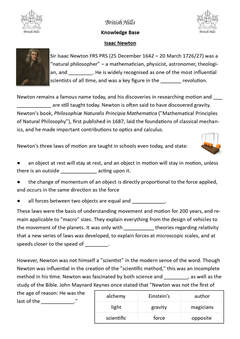
Click on the image above to download
|
Check your answers by clicking the image above
|
